Hindu Weddings in the West: A Sacred Union Beyond Borders
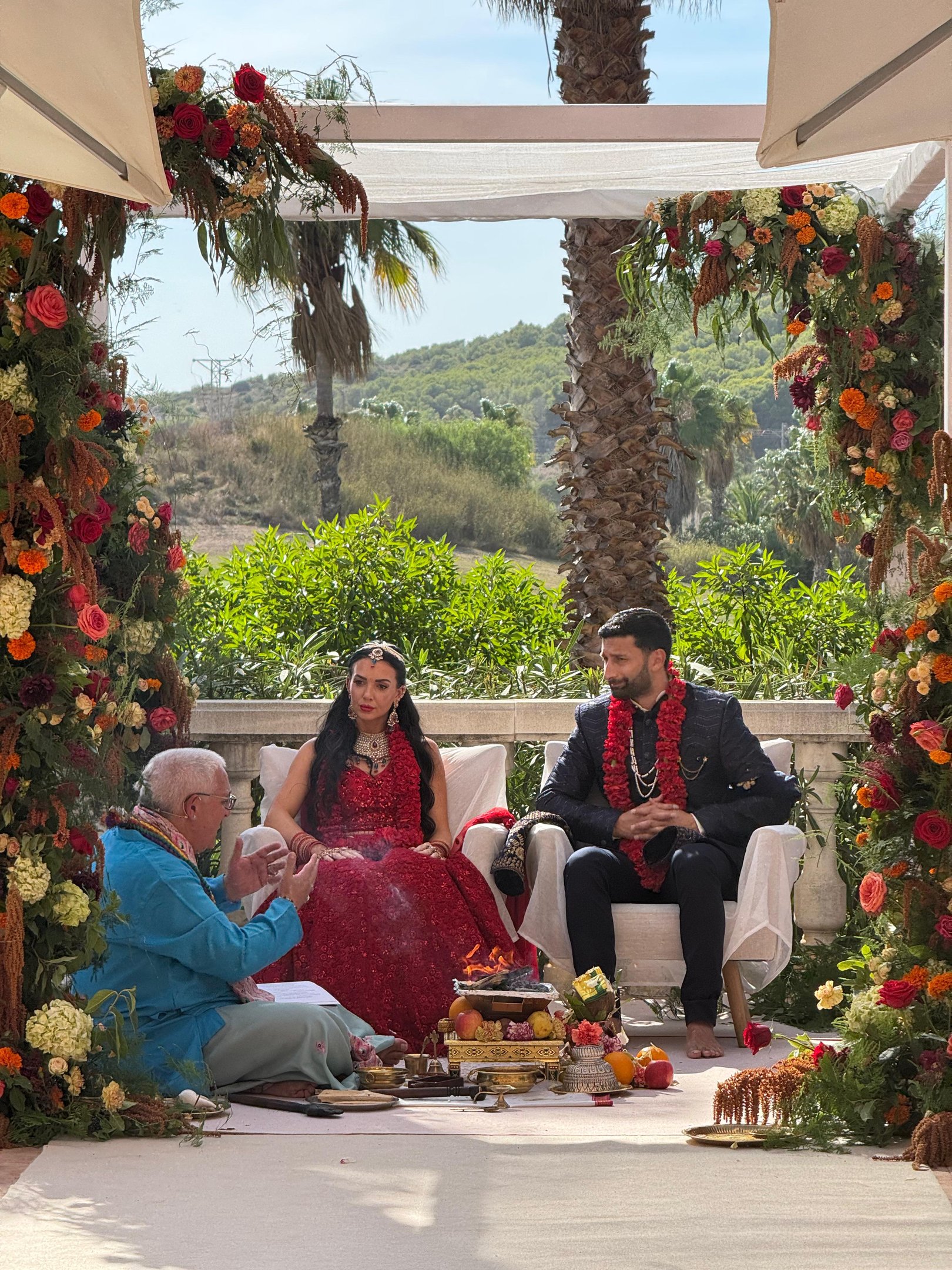
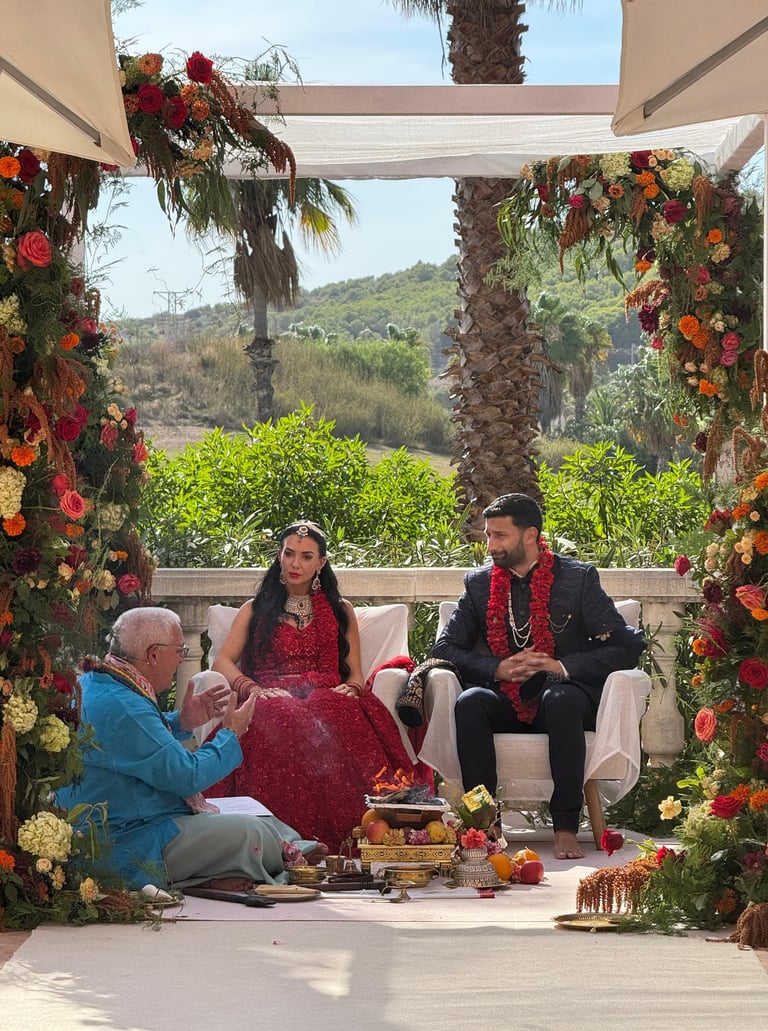
During the year 2025, I have had the honour of officiating twenty four Hindu weddings in different parts of Spain and Europe. Each ceremony has been unique, marked by respect, spirituality, and the couples’ desire to experience their union as a sacred act. These experiences confirm that Hindu tradition is not only alive in the West, but that it adapts with dignity to new times and contexts, preserving its spiritual depth and universal message.
Pandit Krishna Kripa Dasa · Hindu Purohita · Officially Recognised Minister of Worship by the Government of Spain
1/22/20264 min read
Vivaha Samskara: A Ceremony with Soul
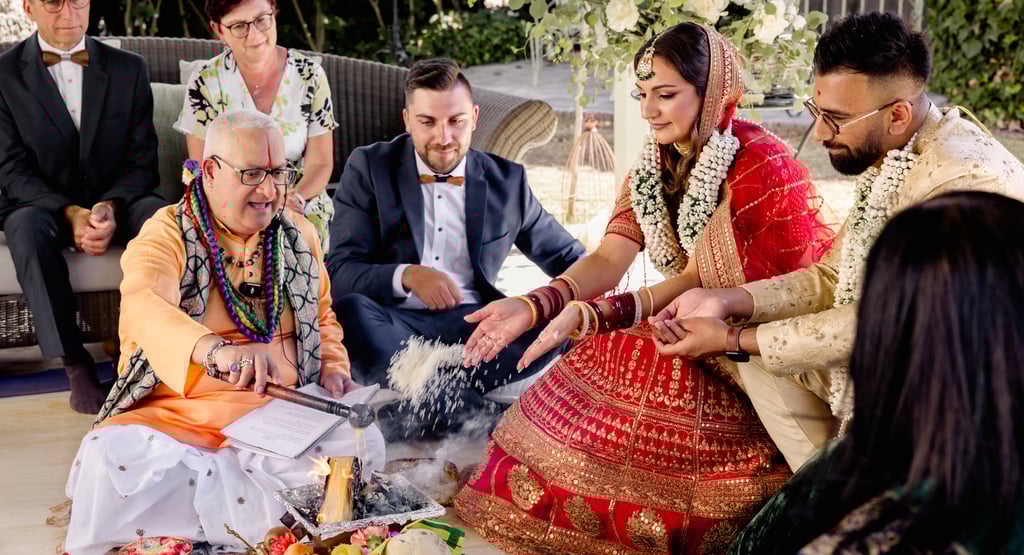
In Hinduism, marriage (vivaha samskara) is one of the sixteen sacred rites (samskaras) that mark the fundamental stages of life. It is considered the oldest continuously practised matrimonial rite in human history, with more than 5,000 years of tradition.
Marriage is understood as a spiritual union rather than a mere contract, in which two souls commit to walking together under the guidance of dharma, the cosmic order. The ceremony, performed in the presence of the sacred fire (agni), invokes the blessings of the devas—divinities that represent different aspects of a single ultimate reality—thus establishing a sacred bond between the spouses and the divine principle.
Every part of the ritual carries deep symbolism. For example, the four pradakshinas (or pheras), the circumambulations around the fire, represent the essential aims of married life: dharma (duty), artha (prosperity), kama (love), and moksha (liberation). This is followed by the saptapadi, the seven steps accompanied by seven vows or promises that seal the couple’s spiritual and ethical commitment. This moment is considered one of the most sacred in the entire ceremony and symbolises the true beginning of their shared path.
Historic Milestones in 2025
This year has been particularly significant. I have had the privilege of officiating ceremonies that mark milestones in the history of Hinduism in Spain:
The first Hindu–Jewish wedding co-officiated in Spain, celebrated in Marbella together with a female rabbi. It was a beautiful example of living interreligious dialogue, in which both traditions harmonised with respect, sensitivity, and depth. The Jewish bride and the Hindu groom were both born and reside in the United States.
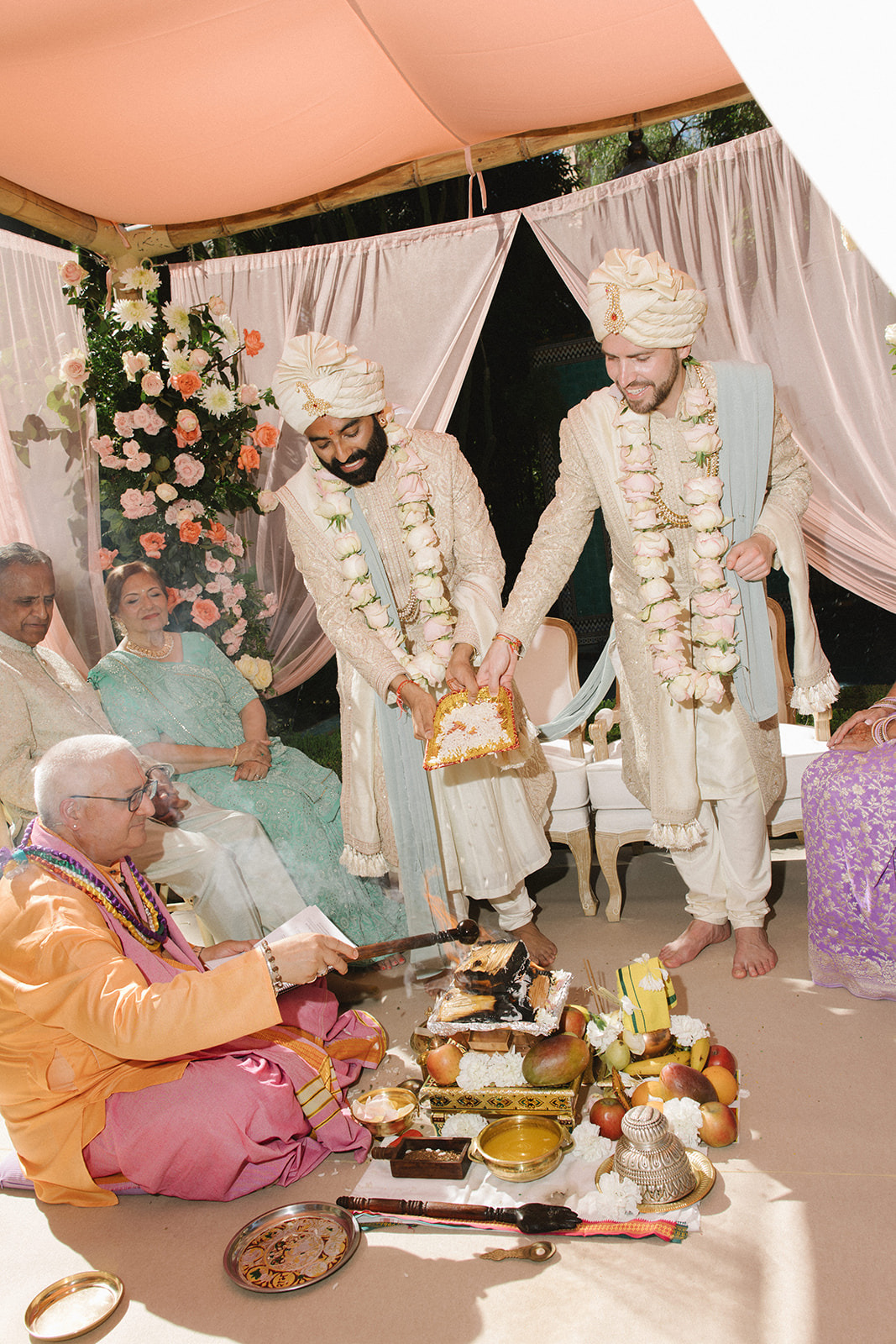
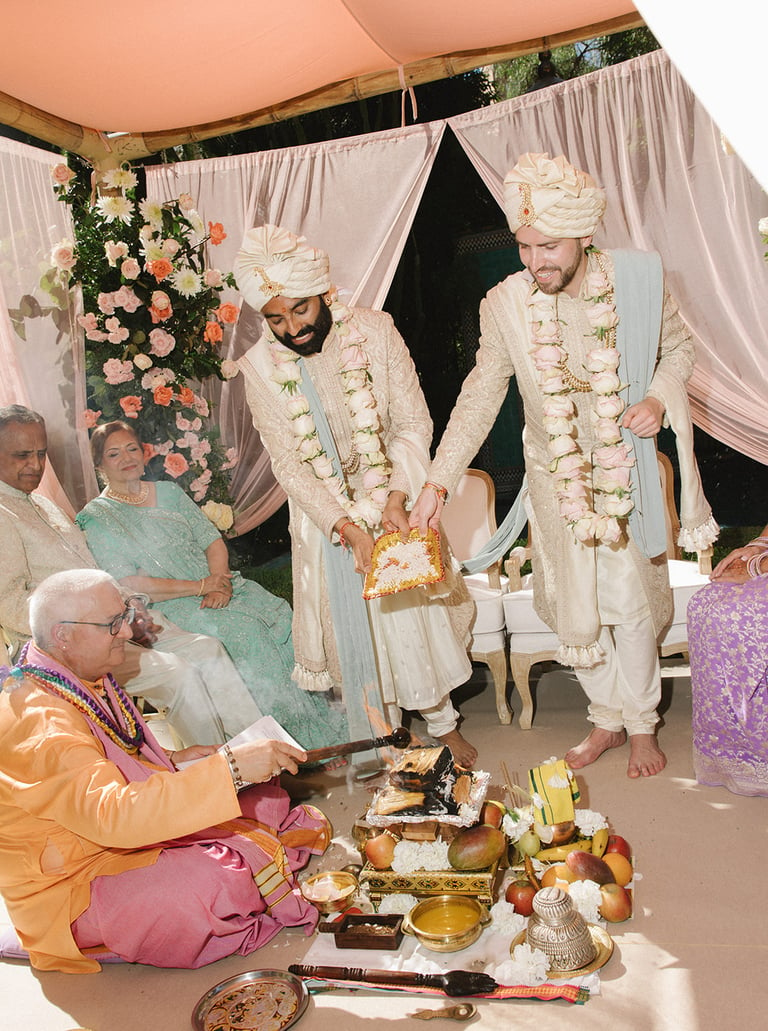
The first Hindu wedding of a same-sex couple in Spain, involving two devotees from the United States. It was a fully authentic Hindu ceremony, sensitively adapted, reaffirming that true dharma does not discriminate but embraces all beings with sincerity and devotion. This type of ceremony is known as Sambandha Karma, or the blessing of a couple.
These milestones reflect that Hindu spirituality possesses not only the depth of tradition, but also the breadth of heart to accompany social and cultural change without losing its essence.
Interfaith Marriages: Specialisation and Service
One of the aspects I value most in my service as a priest is the opportunity to unite people of different faiths within a meaningful and respectful ceremony. Over the years, and especially in 2025, I have had the honour of officiating marriages between Hindus and Christians, Jews, Muslims, and people with no formal religious affiliation, creating spaces where love, respect, and dharma intertwine.
Each ceremony is carefully prepared through prior dialogue, linguistic adaptations, and cultural explanations, ensuring that all those present understand and feel the depth of the act. These interfaith marriages do not only unite couples; they also build bridges between communities, fostering coexistence and spiritual understanding.
Ceremonies Across Spain and Europe
Throughout the year, I have officiated weddings in cities as diverse as Madrid, Barcelona, Alicante, Ceuta, Seville, Palma de Mallorca, Málaga, and Santiago de Compostela, reflecting the growing presence and acceptance of Hinduism throughout Spain. I have also been invited to conduct ceremonies in Lisbon (Portugal), Nice (France), and Milan (Italy), demonstrating the strength of the vivaha samskara beyond cultural borders.
Whether in the landscapes of Spain, in Portugal, on the French Riviera, or in Italy, the Hindu rite has shown itself to be fully adaptable to each setting without losing its essence or spiritual integrity. In every celebration, the connection with the sacred has been tangible and profound.
Languages and Multicultural Connection
I officiate ceremonies using the traditional prayers in Sanskrit, the liturgical language of Hinduism, accompanied by translations and explanations in Spanish or English, according to the needs of the couple and guests. This ensures that the ceremony is accessible, understandable, and meaningful for everyone present. In addition, I speak Hindi and Italian fluently, which further facilitates connection with families from diverse cultural backgrounds.
Institutional Recognition and Spiritual Vocation
As a Vaishnava practitioner for more than forty years and a Hindu priest (purohita) ordained in India three decades ago, I have dedicated my life to the study, teaching, and practice of Hinduism. In 2022, the Government of Spain officially recognised me as a Hindu Minister of Worship, an important step for the visibility of Hinduism within the framework of the country’s religious pluralism.
At present, Hindu wedding ceremonies do not have legal recognition by the Spanish State. However, as a Minister of Worship, I am able to issue a certificate for testimonial or spiritual purposes, which many couples value as a meaningful part of their commitment. The ceremony can be celebrated alongside the corresponding civil procedure, thus respecting both dimensions: the legal and the spiritual.
Balancing Tradition and Sensitivity
After so many years of service, I can say that each couple represents a unique world. Some approach with deep and sincere faith, seeking a spiritual bond; others do so to honour family expectations, especially those of parents or elders. Some wish to sanctify their union without adhering to a specific sampradaya (school or lineage within Hinduism), while others request adaptations to make the rite shorter, more modern, or more inclusive.
In each case, regional variations within India are also considered, as there are subtle differences between Gujarati, Punjabi, Tamil, Marathi, or Sindhi traditions, as well as the particular customs of each family or community. As a priest, I strive to listen with empathy, guide with clarity, and adapt with balance, without losing the essence of the vivaha samskara. My duty is to honour tradition while accompanying people in their lived realities, ensuring that the ceremony is not only beautiful but also meaningful and transformative.
Love Guided by Dharma
In every wedding I officiate, I remind the couple that the sacred fire before which they take their vows represents the divine presence in their lives. This is not merely ritual, but a spiritual seed planted in the heart of the new home. True marriage is not a signature, but a daily decision to walk together with respect, patience, truth, and compassion.
The growing presence of Hindu weddings in this part of the world is not an exotic trend, but a sign that many people are seeking union with soul, spirituality with meaning, and love with purpose. My role as a purohita is simply to facilitate that encounter. For when two souls unite before the sacred, not only is a couple born—a small temple comes into being in the heart of the world.